

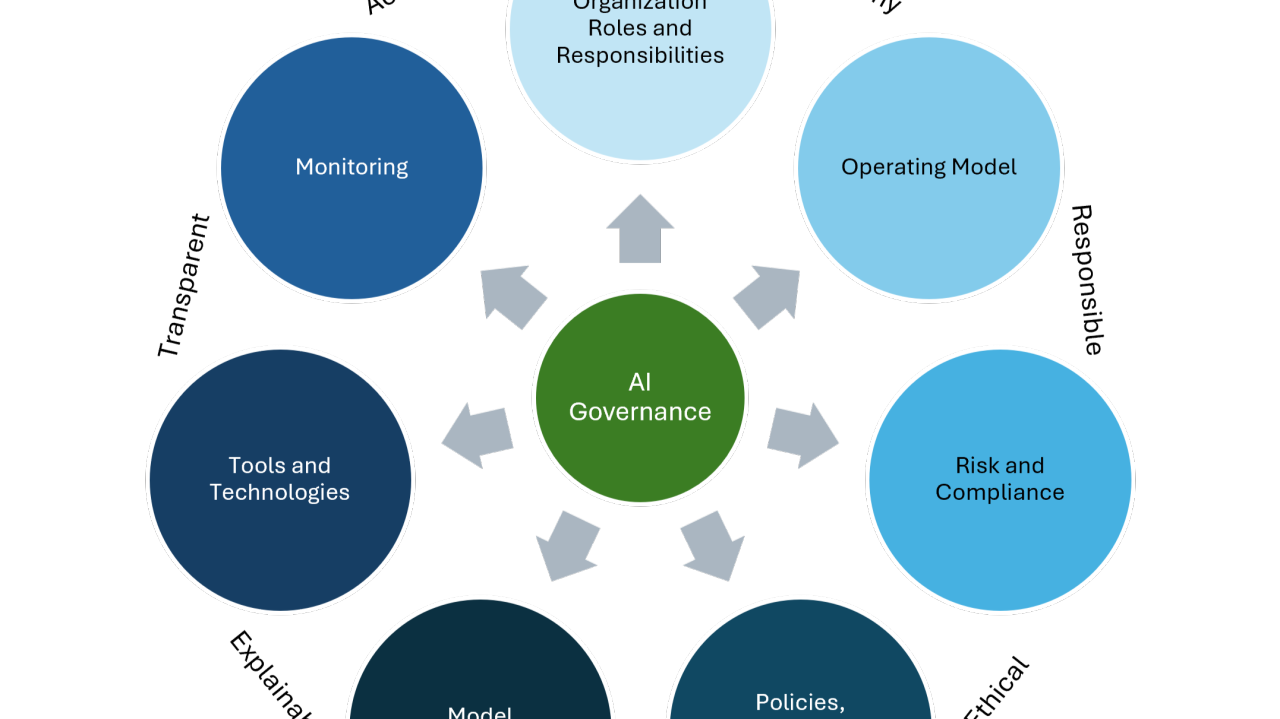
AI governance is not bureaucracy for its own sake. It is the set of policies, processes, and accountability structures that allow organisations to deploy AI services and AI solutions at scale while managing the risks that come with automated decision-making. Organisations that treat governance as an enabler rather than an obstacle build it into their AI operating model early and find that it accelerates deployment rather than slowing it, because teams spend less time reworking systems that fail governance reviews and more time on productive development.
The foundation of effective AI governance is an inventory of the AI systems in use across the organisation, with clear documentation of what each system does, what data it uses, what decisions it influences, and who is accountable for its performance. This inventory is the prerequisite for every other governance activity, because you cannot monitor, audit, or update systems you have not catalogued.
Risk tiering provides a practical mechanism for calibrating governance intensity to risk level. A content recommendation system that surfaces marketing emails requires different governance oversight than a credit decision system that determines loan approvals or a clinical decision support system that influences treatment recommendations. A tiered framework applies proportionate scrutiny: lighter governance for low-consequence applications, more intensive oversight for high-consequence systems.
Pre-deployment review is the governance checkpoint that prevents problematic systems from reaching production. A review that evaluates model performance, fairness characteristics, explainability, data lineage, security posture, and regulatory compliance before deployment is far less expensive than discovering these problems in production. The review process should be designed to be rigorous but efficient, with clear criteria and consistent timelines that do not become a bottleneck.
generative AI development services require governance provisions that address output quality, factual accuracy, content safety, and attribution, in addition to the model performance and fairness considerations that apply to traditional AI systems. These provisions should be designed for the specific risks of generative applications rather than adapted from frameworks designed for predictive models.
