

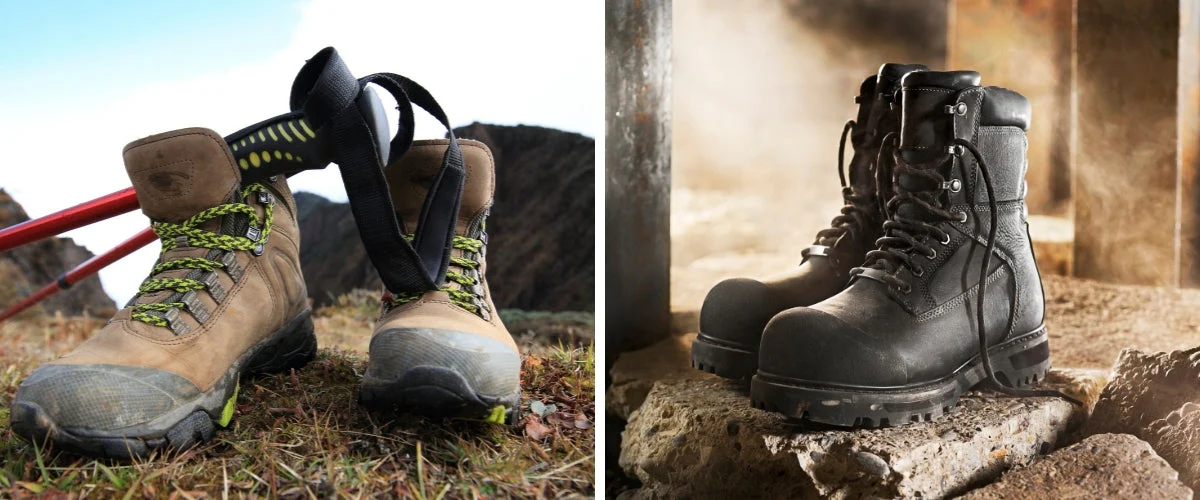
At first glance, the overlap between hiking boots and work boots appears significant enough to make the distinction feel like a matter of preference rather than performance. Both are built for demanding physical environments. Both prioritise durability, foot protection, and traction over the kind of refined aesthetics associated with casual footwear. Both are frequently constructed from leather and rubber, with reinforced toe areas and outsoles engineered for uneven terrain. But the decision between hiking boots vs work boots is one that carries real consequences when it is made without understanding what separates the two categories at a construction level — and why those differences matter enormously in the specific environments each boot was designed to perform in.
Different Problems, Different Engineering
The foundational distinction between hiking boots and work boots is not aesthetic. It is a difference in the primary problem each category was engineered to solve.
Hiking boots are designed around the biomechanical demands of sustained foot travel across natural terrain — trail surfaces, elevation change, loose rock, wet ground, and the full variety of conditions encountered in wilderness and backcountry environments. The engineering priorities are weight management, terrain adaptability, moisture control, and the kind of cushioning and energy return that sustains comfort across miles of continuous movement under a loaded pack.
Work boots are designed around the occupational hazard profile of industrial, construction, and trade environments — falling objects, compression loads, puncture risks, electrical exposure, and the sustained static and dynamic loading of a long shift on hard surfaces. The engineering priorities are protective rating compliance, structural durability under repeated heavy use, and the kind of support and stability that prevents fatigue injury across extended standing and walking on concrete, steel, and uneven job site surfaces.
These are genuinely different engineering briefs, and the boots that result from them reflect those differences in ways that become consequential when one is used in the other’s environment.
Where Hiking Boots Fall Short on a Job Site
Hiking boots perform admirably in the environment they were designed for. Taken onto a construction site, manufacturing floor, or trade environment, several of their defining characteristics become liabilities.
The most immediate is protective specification. The majority of hiking boots carry no occupational safety ratings — no ASTM impact or compression protection, no puncture-resistant midsole plate, no electrical hazard rating. On job sites where these protections are mandated by occupational safety regulations, a hiking boot is not simply a suboptimal choice. It is a non-compliant one that exposes the wearer to genuine injury risk and the employer to regulatory liability.
Beyond compliance, the outsole compounds optimised for trail traction — typically softer rubber formulations with aggressive lug geometry designed for soft ground grip — wear significantly faster on the hard, abrasive surfaces of a job site than the harder rubber compounds used in purpose-built work boot outsoles. A hiking boot that lasts five hundred trail miles may show significant outsole wear after a fraction of that in a construction environment, with corresponding reductions in traction and protection.
The midsole cushioning systems in hiking boots, while excellent for the impact demands of trail movement, are not engineered for the compression loads of heavy equipment proximity or the sustained static loading of a shift spent primarily standing. Work boot midsoles are built to a different durability standard that reflects the different nature of the load they carry.
Where Work Boots Fall Short on the Trail
The limitations of work boots in a hiking context are different in character but equally real in their effect on performance and comfort.
Weight is the most immediate variable. Work boots built to occupational safety specifications — steel toe caps, puncture-resistant plates, heavy-duty outsoles — carry significantly more mass than hiking boots of equivalent height. On a job site where movement patterns involve shorter distances and frequent static load, that weight is manageable. On a trail where continuous movement across miles of varied terrain is the defining demand, the same weight becomes a genuine physical tax that compounds across the distance covered.
Midsole flexibility is the second significant variable. Work boots are built with substantial shank stiffness to provide underfoot stability on job site surfaces and to resist the torsional loads of ladder and scaffold work. On natural trail terrain, that same stiffness resists the flex and articulation that efficient trail movement requires, increasing the energy expenditure of each stride and reducing the responsiveness that technical terrain demands.
Moisture management in work boots is typically oriented toward durability and waterproofing rather than the breathability and rapid moisture evacuation that hiking boots prioritise for sustained aerobic activity. A work boot that keeps water out effectively on a wet job site may trap the perspiration generated by sustained hiking effort in ways that cause discomfort and skin breakdown across a long trail day.
The Hybrid Category and Its Genuine Limitations
A category of boots marketed as suitable for both hiking and work environments has grown significantly in recent years — constructions that attempt to occupy the middle ground between trail performance and job site protection. For wearers whose use case genuinely spans both environments in relatively moderate applications, a well-chosen hybrid construction offers a practical consolidation of footwear.
The limitation of the hybrid category becomes apparent at the more demanding end of either use case. A boot that carries basic safety toe protection and reasonable trail capability will not perform at the level of a purpose-built work boot in a heavy industrial environment, or at the level of a purpose-built hiking boot on technical backcountry terrain. Understanding where the hybrid trade-off sits relative to the actual demands of both environments is the key evaluation question for any buyer considering this approach.
BootsPlusMore carries both dedicated work boots and hiking boots across the full range of construction specifications — alongside hybrid constructions for wearers whose use case warrants them — with guidance designed to help men and women identify the right boot for their specific environment rather than the one that appears to cover the most ground on paper.
