

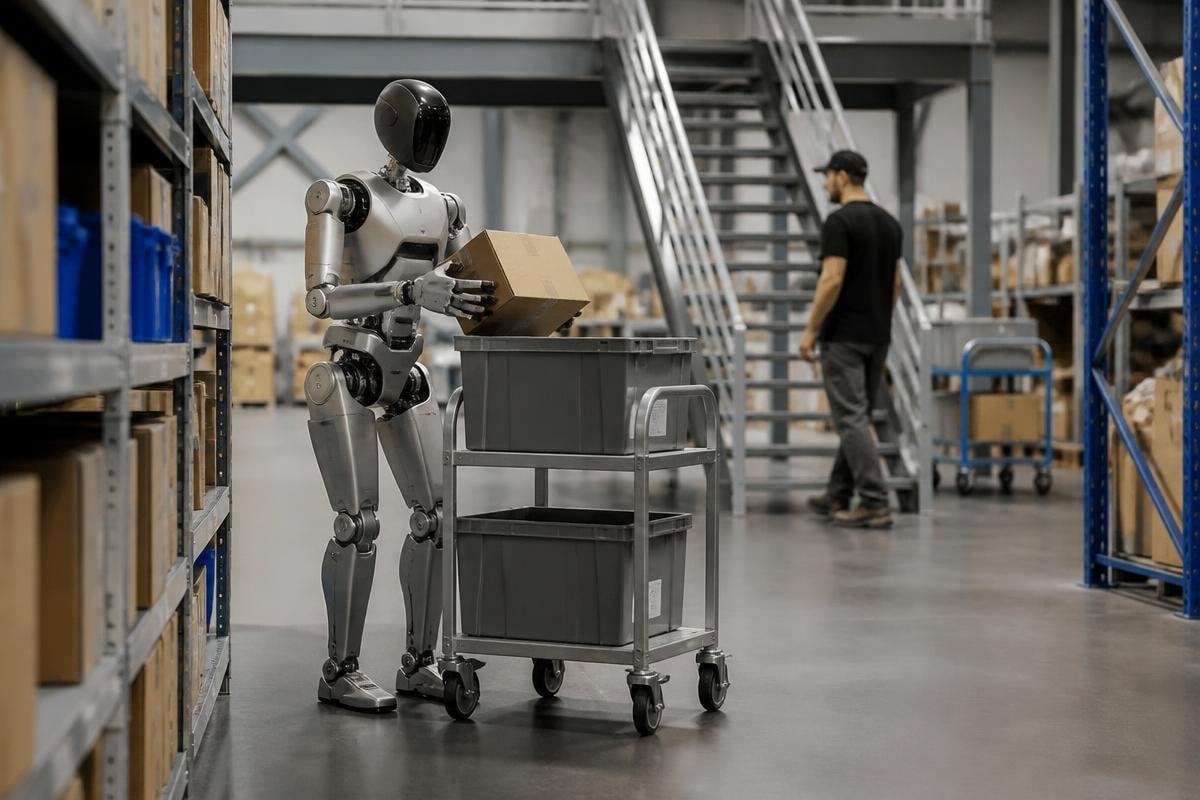
A warehouse built for people already has stairs, shelves, carts, doors, and workstations sized around a human body. Humanoid robots could use that same space, but they’ll need to handle far more than walking and lifting before they can earn a place on a live shift.
Quick read
- Humanoid robots may fit into existing warehouse layouts without a full rebuild.
- Picking mixed items is harder than moving a fixed load between two points.
- Safety, uptime, charging, and cost will decide whether the machines stay after a pilot.
Why a human shape could help
A robot with two arms and two legs can, in theory, reach shelves, carry a tote, open a door, and use equipment made for people. That matters to a warehouse manager who can’t close a site for a major layout change.
The shape alone solves very little. A robot still needs cameras and other sensors to locate an item, software to plan its movement, and enough balance to work near people. It also needs hands that can hold objects with different sizes, surfaces, and weights.
That last part is where warehouse work gets difficult. Moving a box from a marked point to another marked point is controlled. Picking an unknown item from a crowded bin is not. The robot has to see the item, choose a grip, lift without damage, and place it in the right container.
The work has to fit the robot
Warehouses contain repeatable tasks, but they rarely contain perfect conditions. Packaging can bend. Labels can face away from a camera. A tote can sit a few centimetres out of place. A person can fix each problem without stopping to calculate every movement.
A humanoid robot must handle those small changes at a useful speed. If a person has to guide it through every awkward pick, the robot may move the task rather than remove work from the shift.
The best early jobs will likely have clear handoffs and limited item types. A robot might move empty totes, transfer known packages, or feed a station that already controls the item position. These jobs give the system fewer chances to fail before a warehouse team learns where it helps.
Uptime matters more than a good demo
A warehouse manager needs a machine that works through a full operating period, not one that completes a short task under close supervision. That requires a battery plan, safe charging, quick recovery after a stop, and a way to restart a task without losing the order.
A robot that walks well but spends long periods charging can leave its human partner waiting. A robot that needs a remote operator whenever its grip slips can also create a new staffing cost. Those details belong in the purchase case from the start.
A warehouse pilot can look cheap when remote operators and technicians sit outside the task count. Robot24 can connect those support hours with the machine and site involved, so you can price the staffing plan before adding more work areas.
The open question is how much human support each robot will need. A pilot may look productive if one technician watches a small group of machines. That same setup may cost too much when the warehouse adds more work areas.
Safety changes the layout
People and mobile robots already share warehouse floors, but a humanoid adds arms, hands, and a taller moving body to the risk assessment. The system needs clear stopping rules, speed limits near people, and a safe response when a person enters its path.
The robot also needs a physical stop control that workers can reach quickly. Its hand and foot movements must stay predictable when the robot loses sight of an item or detects an obstacle. A smooth demo does not answer those questions.
Safety affects output too. A robot that slows down often near workers may handle fewer tasks than its paper speed suggests. That lower rate might still work for a simple transfer job, but it weakens the case for fast order picking.
What to check before buying
A warehouse team can use this checklist before agreeing to a humanoid pilot:
- Name the task: record the exact shelf, tote, item range, and handoff.
- Measure support: count the people needed to watch, reset, or guide the robot.
- Track stops: log every pause, failed grip, safety stop, and remote intervention.
- Check recovery: confirm how the robot resumes work after a blocked path or dropped item.
- Price the full setup: include charging, floor changes, training, service, and spare parts.
Those records give you a better answer than a task video. They also show whether the robot helps the warehouse team or needs too much care to earn its space.
I’d wait before replacing a proven picking system with a humanoid robot. A focused pilot can make sense where the machine uses existing space and handles a repeatable task, but the purchase case should rest on measured uptime and human support hours, not the shape of the robot.
The machines that change warehouses will be the ones that finish a shift, recover from ordinary errors, and show their cost in the same report.
